Curling Haus Est. MMXI

Before you play

Curling 101

A crash course in the basics. Work through the sections and you’ll step on the ice knowing what you’re doing.

01History

Curlers on a frozen Scottish loch in the 1800s, in long coats and hats, with straw brooms.
Two hundred years ago, on a frozen loch. Same stones, same brooms, same standing about in the cold.

The oldest curling stone we have is carved with the date 1511. It sits in a museum in Stirling, found with a second stone dated 1551 when somebody drained a pond in Dunblane. The first written record turns up in 1540, when a notary in Paisley wrote down a challenge between a monk and a local man.

For most of the next three hundred years this was played outdoors on frozen lochs, by people who then went inside to a fire. The customs came out of that, and they came first. The rules were only written down nationally in 1838.

That order explains how the game still behaves. Curling has no referee at club level. Players call fouls on themselves, agree the score between them, and the governing body prints a passage about conduct on the page before the first rule.

02Equipment

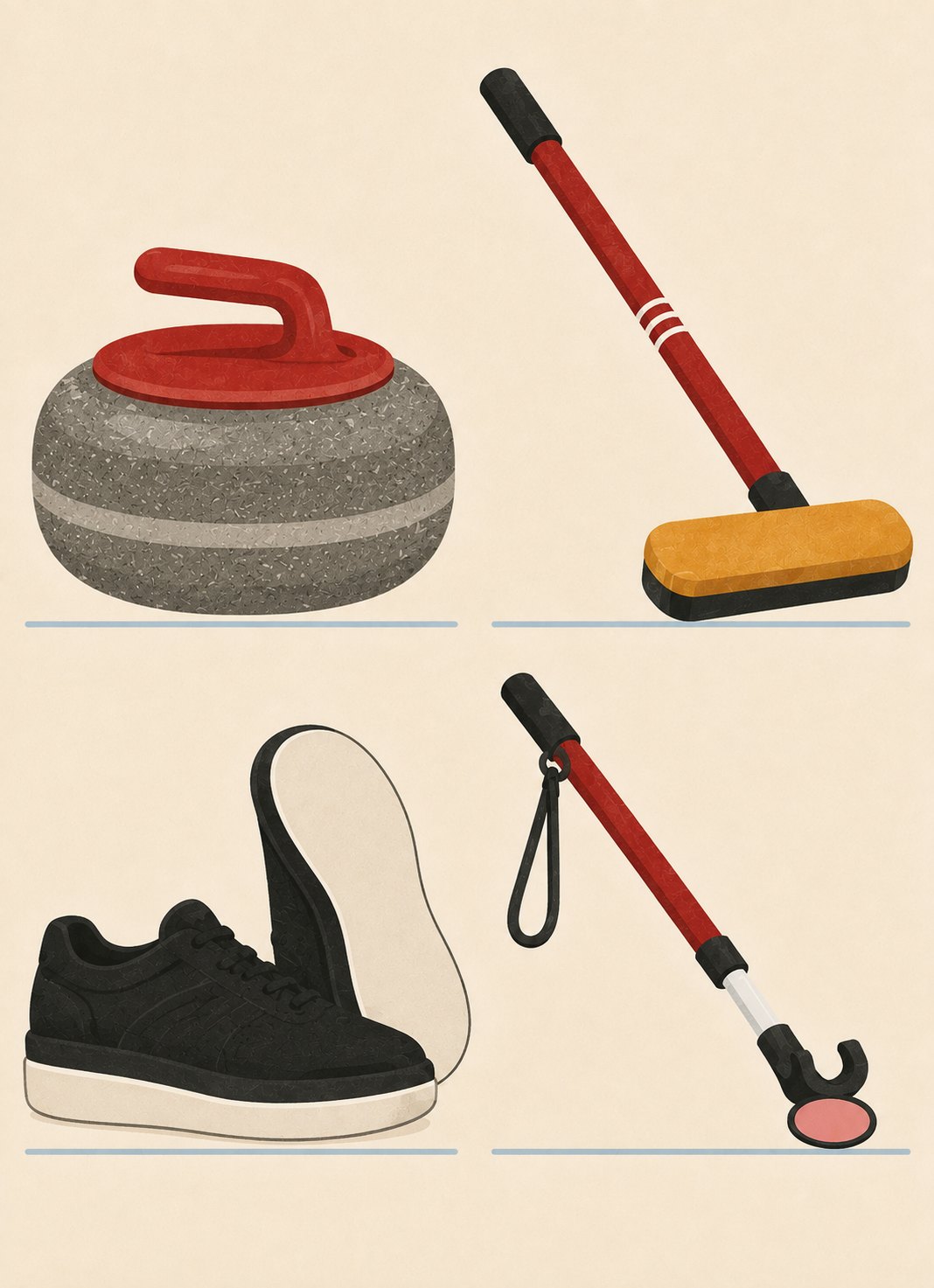
A curling stone, a broom, a curling shoe and a delivery stick, laid out.
Everything you need. The club lends you all of it - you bring clean trainers.

The stone

Granite, and heavier than it looks: between 38 and 44 pounds. Nobody picks one up. You push it and let the ice carry it. Each team throws eight in an end, two per player.

The ice, which is not flat

Before play the ice is sprayed with water droplets that freeze into small bumps. This is pebble, and the stone rides on the tops of it.

Most of what follows depends on this. Pebble is why sweeping works, why a stone curls, why street shoes are banned, and why you keep hands and knees off the ice. Body heat melts pebble. So does grit off a boot.

Shoes

One foot slides and one foot grips. The sliding shoe has a slick sole; the other has rubber. Once you know which foot is which, standing on curling ice stops being alarming.

The broom

Two jobs. You sweep with it, and you lean on it for balance while you deliver. The second one is what keeps you upright.

The delivery stick

A stick that clips onto the stone's handle so you can deliver standing up instead of going down into the slide. It is in the rules of the sport, and the only real restriction is at world championship level.

It has nothing to do with age. People use one because sliding out of the hack is hard on the knees, and a stick keeps them playing. If your knees are a question mark, use one and enjoy the day.

What does that actually look like?
A curler delivering a stone while standing upright, using a delivery stick clipped over the handle.
Upright, both hands on the stick, stone on the ice. That is the whole of it.

03Gameplay

A game is two teams of four. Eight people on the ice, sixteen stones between them, and that is the whole cast. Our day has four teams, so two games run side by side on the two sheets.

Each team throws in a fixed order that is set before the game starts and does not change: lead, second, vice, skip. Everyone throws two stones, and you throw in your slot in every end. The teams alternate, so the stones go red, yellow, red, yellow all the way through.

The roles come with the slots, and the two that matter are at the end of the order. The skip runs the team and calls every shot from the far end. The vice takes over calling while the skip is throwing.

The whole sheet, 150 feet You throw from one end at the house on the other. The end you are aiming at Hog line the stone must cross this completely, or it comes off The house 12 ft across. The dot in the middle is the button Back line past it and the stone is out
The middle is cut out here so both ends fit. It is 150 feet long in reality.

You throw from a foothold called the hack at one end toward the rings at the other. The rings are the house, twelve feet across, with the button at the centre.

The thick line fifteen feet in front of the house is the hog line, and it does two different jobs at opposite ends. At your end you must let go of the stone before you reach it. At the far end the stone has to cross it completely or it comes off.

Who throws, and who sweeps

LeadSecond ViceSkip 1 & 23 & 4 5 & 67 & 8 T S S C S T S C S S T C S S C T T — throwing S — sweeping C — calling, from the far end Everyone throws two and everyone sweeps.
Everyone throws two stones and everyone sweeps. The only person who never sweeps is whoever is calling the shot from the far end.

Ends

An end is the unit the game is built out of. Both teams throw all eight of their stones, the score is agreed, and that is one end finished. A full game is eight or ten of them and runs an hour and a half to two hours.

An end is roughly an inning. Both sides get their turn inside it, and you play a set number of them rather than a clock.

Two differences are worth holding on to. Only one team can score in an end, so there is no such thing as both sides putting runs on the board in the same one. And there is nothing like an out — every end runs the same fixed sixteen stones, however well or badly it is going.

We are playing a shorter format than a full game, and the number of ends will be confirmed before we go on.

The hammer

The team throwing the last stone of an end has the hammer. It is a real advantage: the final say on a house that is already full.

In the first end it comes down to a coin flip between the two leads. The winner takes the hammer nearly every time, and the loser picks which colour of stone to throw. After that it changes hands on its own.

End 1 H Red has the hammer Red scores 2 End 2 H Yellow has it now because red scored Scoring costs you the hammer. So taking a single point while you hold it is a poor end. Teams sometimes throw a stone away on purpose to keep it for the next one.

04Scoring

Only one team scores in an end. The team whose stone is closest to the button is that team, and they score one point for each of their stones closer than the other team's best one. A stone has to be touching the house at minimum to count.

Red scores 2. Yellow scores 0. Two red inside the dashed ring both closer to the button than any yellow Yellow's best stone draws the ring and scores nothing itself
Draw a circle through the other team's best stone. Every stone of yours inside it is a point.

The rings are a measuring aid. A stone on the outer ring beats one on the inner ring if it is closer to the button.

When two stones are too close to call by eye, somebody fetches a measure — an arm that pivots on the button and swings round to compare them. It settles it, and it is the closest thing to a referee you will see all day.

The scoreboard on the wall

Club scoreboards work differently from the ones on television, and almost everybody reads them backwards the first time.
After three ends Red 3 in the first end, yellow 2 in the second, red 2 more in the third. 123 456 78 1 3 2 Red hung a 3 beside the 5 Not "red scored 3". It means red reached 5 points, in the third end. The printed row is the running total. The card you hang is the end.

The printed row down the middle is the running total. The card you hang is the end it happened in.

05Delivery & Sweeping

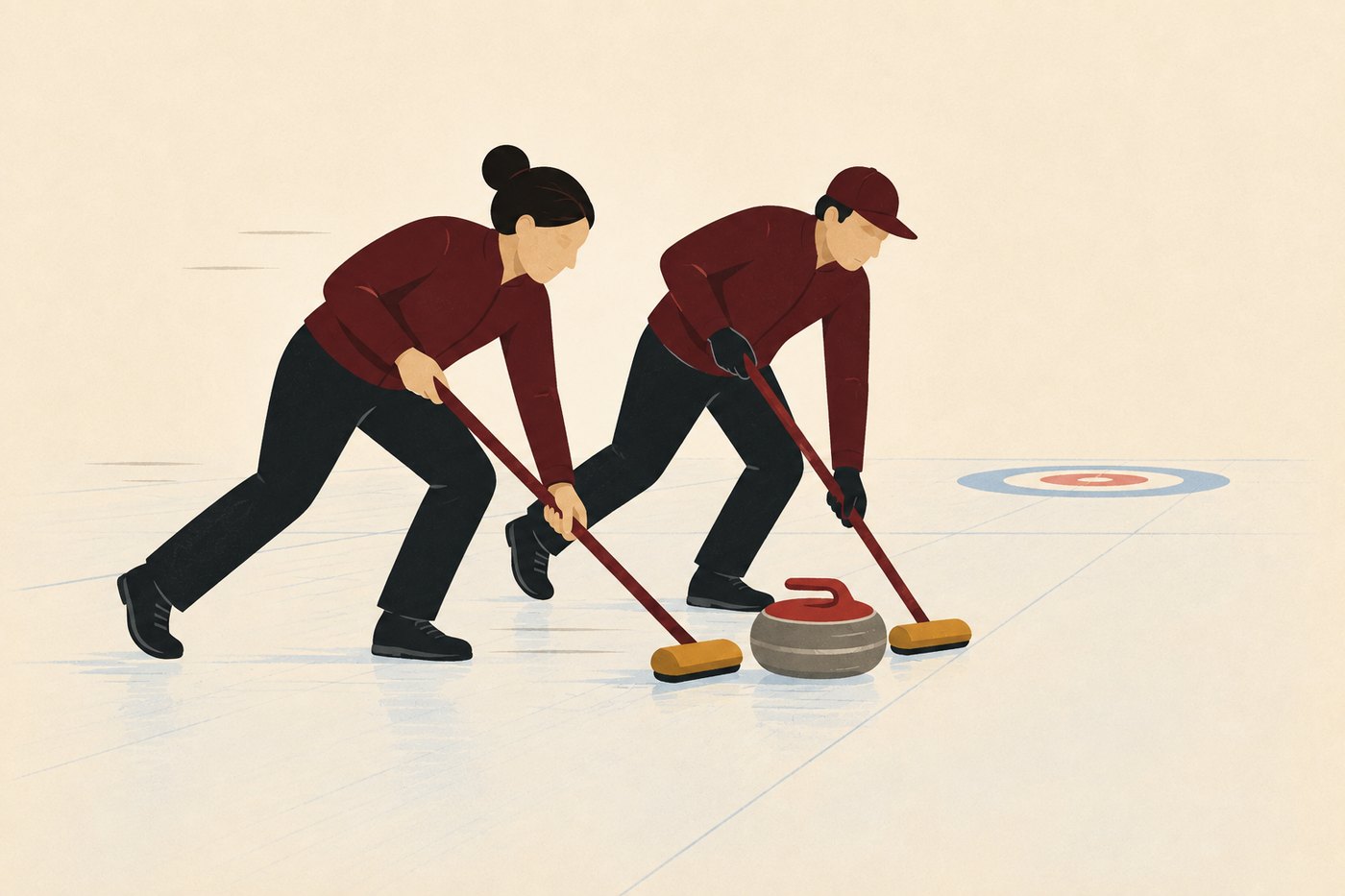
Two curlers sweeping hard in front of a moving stone as it travels towards the house.
Sweeping. Both brushes stay just in front of the stone, and everyone moves with it.

The only part of this page that teaches something physical, and the part worth watching rather than reading.

Watch for four things
  • How the feet are set in the hack before anything moves.
  • The pull back, then the push out. One motion, slower than you expect.
  • The hand turning the handle at release. That is what makes the stone curl.
  • The sweepers staying beside the stone rather than in front of it.

Discover Curling, produced by World Curling and Curling Canada. It covers the delivery stick as well.

A throw is three things. The line you send it on, the weight you put behind it, and the turn you put on the handle. Your skip hands you the line and the turn before you throw. Weight is the one that is yours.

The five phases

  1. foot in the hack, stone in front 1Setfoot in the hack, stone in front
  2. hips rise, the stone draws back 2Pull backhips rise, the stone draws back
  3. drive off the hack, the stone leads 3Push outdrive off the hack, the stone leads
  4. low and long, broom out for balance 4Slidelow and long, broom out for balance
  5. turn the handle and let it run 5Releaseturn the handle and let it run
From the side. The video above is where the detail is; these are here so you can check yourself against it on the day.

Which hack

centre line left right Right-handed use the LEFT hack Left-handed use the RIGHT hack
Throw from the wrong one and the stone comes off. It is the easiest mistake on this page to avoid.

Which way it curls

Clockwise curls to the right skip says “in-turn” Counter-clockwise curls to the left skip says “out-turn” Those two names swap over if you throw left-handed. Clockwise and counter-clockwise never change, so that is the safer way to hold it in your head.
Those two names swap over if you throw left-handed. Clockwise and counter-clockwise never change, so that is the safer way to hold it in your head — and it is what the picture above is showing.

A stone curls in the same direction it is spinning, which is the opposite of what a spinning ball does. Physicists have argued about why for a century without settling it. The behaviour is completely predictable, which is all anybody needs on a Sunday.

What sweeping does

thrown Swept goes farther, and straighter Not swept stops short, and curls more Sweeping cannot make a stone stop shorter, or make it curl more.
When somebody is shouting at you to sweep, they have judged the stone is short or curling too much.

What you will actually hear

Nobody shouts "sweep, please." The calls are Sweep, Yes, Yup and Hard, and they all mean the same thing: brush, now. The volume is about distance rather than temper. Whoever is calling is a hundred feet away.

Weight is the one thing this page cannot teach you. How hard to push is learned by throwing stones, which is what the ice time is for.

06Strategy

Your skip calls every shot, so none of this is on you to work out. It is here because an afternoon of curling makes far more sense once you know what the two teams are actually trying to do.

There are three shots

Draw Throw it to stop somewhere useful, usually in the house. shields it Guard Park one in front so the other team cannot hit what is behind it. Take-out Hit one of theirs and knock it out of play.

The first stones of an end, thrown by the two leads, are usually guards. The shape of the end is being set before anybody has thrown at the house.

The one idea that explains most of it

Everything turns on who has the hammer, the last stone of the end. The two teams want opposite things, and once you can see that, the whole afternoon reads differently.

The team with the hammer wants a crowded house. More stones in play means more ways to end up with two, three or four of them counting. So they throw guards, tuck stones behind them, and keep things messy. Taking a single point with the hammer is a disappointment, because scoring hands the advantage to the other team.

The team without it wants the ice clean. Fewer stones means fewer things that can go wrong for them. So they hit stones out, keep the middle open, and try to hold the other side to a single point. In curling that counts as a win for the end.

Two words you will hear shouted

A steal is scoring without the hammer. It is the best thing that can happen to a team and the room will let you know.

A blank end is throwing your last stone away on purpose rather than take one point, so you keep the hammer for the next end. It looks like a mistake and it is not.

The broom the skip is holding out is a target, not a signal. Aim at the head of it and let the sweepers do the rest.

07Rules & Etiquette

Two curlers shaking hands on the ice at the end of a game, both teams gathered behind them.
Every game starts and ends with a handshake. This is not a formality here.

Curling polices itself. There is no referee at club level, players call fouls on themselves, and the two halves of this section are really the same subject.

The rules you can break by accident

Every one of these has a plain remedy. A stone comes off, or goes back, or the other team picks what happens. Beginners break all of them and nobody makes anything of it.

And the manners

The rulebook opens with a passage called the Spirit of Curling, printed before the first rule.

"Curlers play to win, but never to humble their opponents. A true curler never attempts to distract opponents, nor to prevent them from playing their best, and would prefer to lose rather than to win unfairly."

"Curlers never knowingly break a rule of the game, nor disrespect any of its traditions. Should they become aware that this has been done inadvertently, they will be the first to divulge the breach."

Where to stand

hog line hog line thrower Stand at the sides between the two hog lines, still and quiet Never down the middle and never walk across a moving stone Only the skip or vice stands in the house

The handshake

You shake hands with everyone on the other team before the game and again after it. The words are "good curling."

And the people watching clap you off the ice at the end. If you came to watch rather than play, that part is yours.

While somebody else is throwing

Stand still and stay quiet, off to the side, out of their eyeline. Phones away.

Say something when they play well

Complimenting a good shot by the other team is expected rather than optional. It costs nothing and it is one of the things that makes the sport feel the way it does.

Look after the ice

Clean shoes before you step on. Keep hands and knees off the surface where you can, because body heat melts pebble. Do not bang the broom on the ice. Food and drink stay off it entirely.

Afterwards

The winning team buys the losing team the first round, and the losers buy the next one. It is called broomstacking, from when players stacked their brooms by the fire and stayed to drink after playing outside all day.

The tradition is the winners looking after the losers. What is in the glass has never been the point, so buying somebody a Coke counts exactly the same.

A warm clubroom after a game: people of all ages round a table, brooms stacked against the wall.
Broomstacking — the bit afterwards. Winners host the losers, and half the room never touched a stone.

08Curling Terminology

Index tap to open
Hack
The foothold you push off from.
House
The rings you are aiming at.
Button
The small circle at the dead centre.
Hog line
Release before it at your end; the stone must cross it at the far end.
End
One round. Sixteen stones, then the score.
Hammer
The last stone of an end, and the advantage that comes with it.
Skip
The player directing the team.
Vice
The one who directs while the skip is throwing.
Lead, second
First and second to throw.
Draw
A stone thrown to stop in or in front of the house.
Guard
A stone parked in front of another to protect it.
Take-out
Knocking another stone out of play.
Biter
A stone just touching the outer ring. It counts.
Pebble
The frozen droplets the stone rides on.
Weight
How hard the stone is thrown.
Hurry
Sweep harder.
Blank end
An end where nobody scores.
Bonspiel
A curling tournament.

09FAQ

So who throws and who sweeps?
Everybody does both. All four players throw two stones each, and while one is throwing, two of the others sweep. The skip stands at the far end calling the shot. There is a diagram of this further down.
Do I need special shoes?
No. The club lends you a slip-on gripper and slider. Bring clean, dry trainers with a flat sole and change into them at the club rather than walking in wearing them.
What if my knees are bad?
Use a delivery stick. It clips to the stone and you throw standing up. It is written into the rules of the sport and has nothing to do with age.
How fit do I need to be?
Not very. Sweeping is the only tiring part and you can wave somebody else in. Plenty of people play into their seventies.
What do I wear?
Layers you can move in, and stretchy trousers rather than jeans. You crouch a lot. Gloves help.
Is it cold?
Cool rather than cold, and you warm up fast once you are sweeping. A fleece is usually plenty. The exception is whoever is calling from the far end — they stand still the whole game, so the skip dresses warmer than everyone else.
What if I fall over?
You will, or somebody will, and it is fine. Falls on curling ice are slow and low. Keeping your weight over the gripper foot when you walk avoids most of them.
Do I need to be any good?
No. Half the people there will have never touched a stone. The point of reading this is so nobody has to start from nothing on the day.

10House Rules

Everything above is true of curling anywhere. This part is true of one building, and it comes from the people who run it.

The waiver

The one below is ours. It says you have read this page and know what you are walking into, and it is not a substitute for whatever release the club itself asks you to sign.

The waiver

Signing for someone under 18? Put their name here as well.

Tick the box

Put your name in and confirm you have read it. That is how the club knows how much of the teaching they can skip, which is the whole reason this page exists.